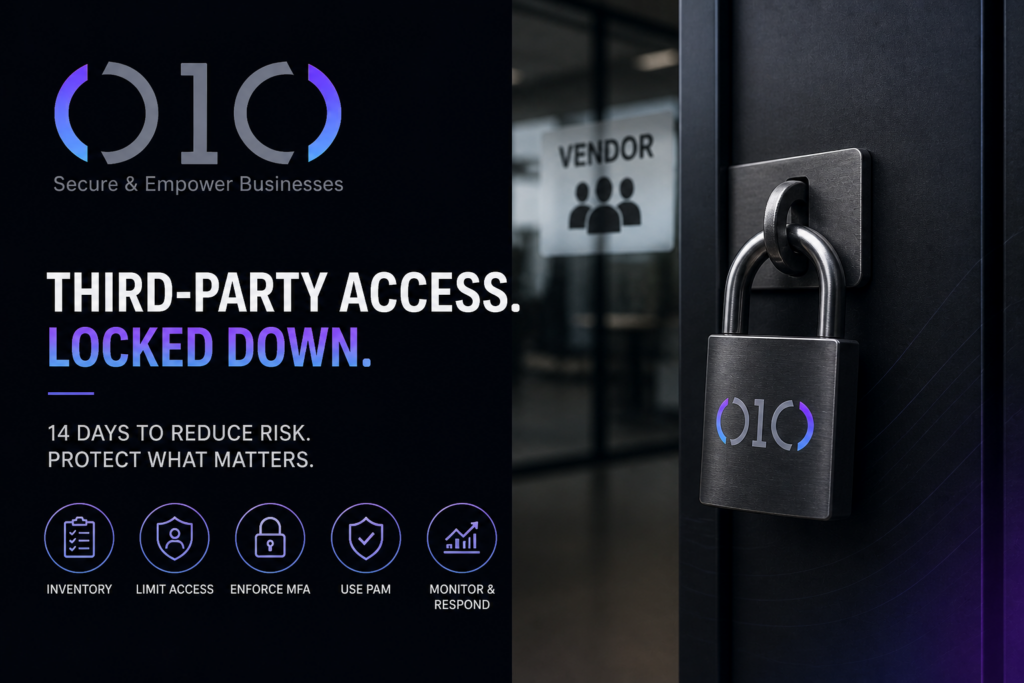
Vendors keep Canadian businesses running – payroll platforms, IT support, HVAC monitoring, accounting apps, the “one quick change” your team can’t do internally. But here’s the ugly truth we see at 010grp: third-party access is the quietest way ransomware gets a free ride into your network.
The myth to kill is simple: “It’s a vendor problem.” No. If your vendor can log into your environment, it’s your risk, your downtime, your breach notifications, and your reputation. Canada’s defenders have warned that supply chains and service providers expand your attack surface and can be used to compromise downstream organizations. The Canadian Centre for Cyber Security lays it out clearly in its guidance on the cyber threat from supply chains.
So let’s talk about a strategy you can actually execute: a 14-day third-party access lockdown that shrinks blast radius without nuking productivity.
Day 1-2: Inventory every outsider with a login
Start with truth, not assumptions. List every vendor and MSP connection: VPN accounts, remote desktop, RMM agents, Microsoft 365 guest access, SaaS admin roles, API keys, and “temporary” accounts that somehow survived three years. If you can’t answer “who can reach what?”, you’re operating blind. This is exactly why we push a formal access review inside our identity and access management work.
Day 3-5: Delete shared logins and enforce real MFA
Shared vendor accounts are un-investigatable. Create named accounts tied to a human, then enforce multi-factor authentication everywhere they touch you. If you’re on Microsoft 365, don’t assume MFA equals safe – attackers bypass weak MFA with token theft and session replay. Read our breakdown in “Your MFA Is Getting Bypassed – Fix Your Microsoft 365 Now” and then tighten Conditional Access to require compliant devices and block risky sign-ins.
Day 6-7: Put vendors behind a locked door, not a flat VPN
A VPN into a flat network is not “remote support.” It’s lateral movement on demand. Segment vendor access so they can reach only the single system they manage, from a known network path, during approved hours. If you’re unsure what segmentation looks like in an SMB, our article “Flat Network? Canadian SMBs Are One Click From Ransomware” is your blueprint. Pair it with network security controls that deny by default.
Day 8-10: Remove standing privilege with PAM
Most vendor access fails because it’s over-privileged forever. Vendors get local admin, domain admin, or “just in case” credentials that never expire. Move privileged actions behind privileged access management so elevation is time-bound, approved, and logged. If you want a practical rollout model, steal the structure from “One Admin Login Can Destroy Your Business – Fix It With PAM in 30 Days.”
Day 11-12: Turn on logging that tells the truth
You don’t need more dashboards. You need proof. If it isn’t logged, it didn’t happen. Centralize VPN, firewall, endpoint, and cloud audit logs, then alert on the few events that matter: new admin creation, new remote tools, mass file access, and after-hours access from unusual locations. If your vendor uses an RMM tool, treat it like a skeleton key and harden it accordingly – our piece “Your MSP Tool Is a Skeleton Key – Here’s How Hackers Use It Against You” shows why.
Day 13: Contract for security
Your vendor contract should answer: who owns incident notification timelines, what MFA is required, how access is reviewed quarterly, and how accounts are disabled on offboarding. Require security awareness training for anyone touching your data, and mandate URL filtering for remote sessions.
Day 14: Prove you can recover if the vendor gets popped
Supply-chain incidents are messy because they spread fast. Backups that “exist” are not enough. Test restores, isolate backup consoles, and protect them with separate credentials and MFA. Start with “Your Backup Is Lying to You,” then align your playbook with Canada’s baseline cyber security controls for small and medium organizations.
If personal information is exposed, you may have breach reporting and record-keeping obligations under PIPEDA. The Office of the Privacy Commissioner of Canada explains mandatory reporting expectations, and Quebec’s regulator outlines confidentiality incident duties for private enterprises. Third-party access is not just an IT issue – it can become a legal and customer-trust issue overnight.
At 010grp, we run third-party access audits, build IAM and MFA enforcement, deploy PAM, segment networks, and wrap it in monitoring, cyber threat intelligence, and an incident response process your leadership can execute. If you want this lockdown done without guesswork, contact 010grp and we’ll turn vendor access from a backdoor into a controlled workflow today.