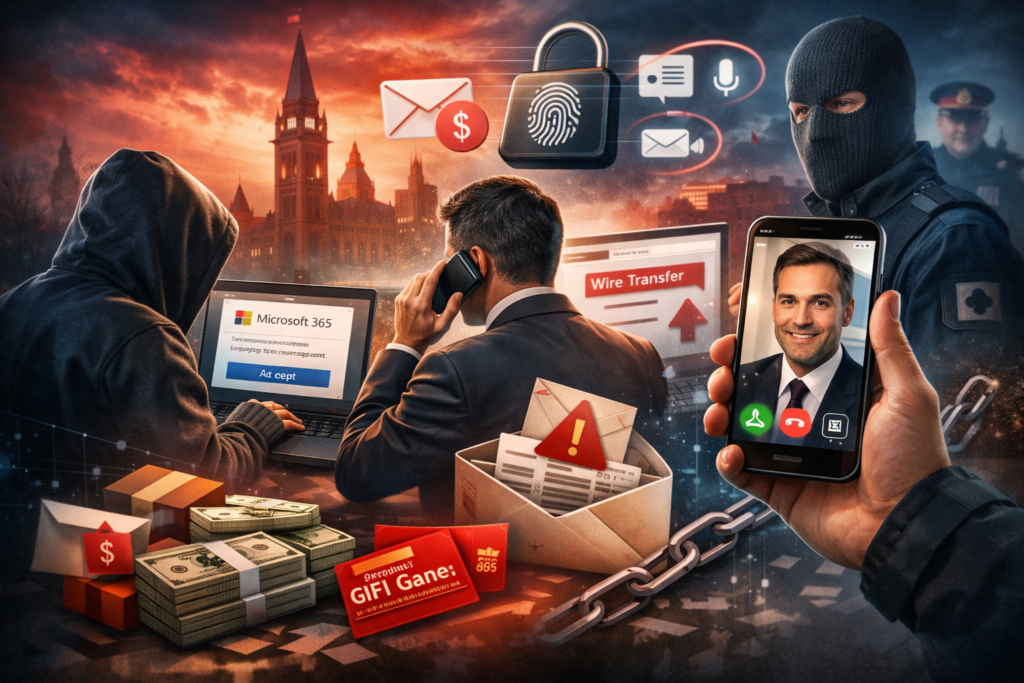
Canadian businesses do not have a phishing problem. They have a trust problem. Attackers no longer need to “hack” their way through a firewall when they can imitate a CEO, copy a vendor thread, or weaponize a real Microsoft 365 login flow. The Canadian Centre for Cyber Security’s National Cyber Threat Assessment 2025-2026 is blunt: cybercrime remains one of the most significant threats to Canada. Add AI-assisted impersonation to that reality, and the old advice – “tell staff to be careful” – becomes security theatre.
At 010grp, our position is simple: if a single email, voice note, or Teams message can move money, expose data, or approve access in your company, your controls are too weak. Criminals are targeting process gaps, not just technical flaws. The RCMP’s guidance on Business Email Compromise shows exactly how payment redirection scams exploit trust, while the Canadian Anti-Fraud Centre reported helping recover CAD $2.3 million in a 2025 BEC case targeting a Canadian law firm. That is not abstract risk. That is Canadian money almost gone.
Here is the myth we need to kill: “We use MFA, so we’re covered.” No, you are not. MFA helps, but it does not fix weak approval workflows, over-permissioned accounts, or employees trained to obey urgency. We have already shown why identity is now the real perimeter in That “Accept” Button Is a Breach: Canadian Microsoft 365 Lockdown and One “Allow” Click and Your Microsoft 365 Is Owned. The lesson is bigger than Microsoft 365: if trust is not verified, it will be abused.
So what actually works? Start with payment integrity. Any request to change banking details, approve a wire, buy gift cards, or release payroll data should require an out-of-band verification step. Not a reply to the same email. Not a number in the signature block. A known-good phone number, a second approver, and a documented callback procedure. This one control stops a shocking amount of fraud.
Next, harden identity like you mean it. Move executives, finance staff, and admins to phishing-resistant sign-in wherever possible. Reduce standing admin rights and use Privileged Access Management so elevated access is temporary, approved, and logged. Tighten Identity and Access Management, enforce strong MFA, and stop pretending passwords are enough. We laid out that path in Your Passwords Are Already Leaked and Stop Using Passwords: Your 30-Day Passkey Plan.
Then fix visibility. Most Canadian SMBs do not fail because they lack tools. They fail because nobody is watching the right signals. New inbox forwarding rules, impossible travel, suspicious consent grants, logins from unmanaged devices, and after-hours admin changes should trigger immediate review. That is where managed detection matters. Our SIEM strategy, security awareness training, and URL filtering are designed to catch the quiet moves before they become public disasters.
Finally, assume one attack will get through. If your recovery plan is “we have backups,” you are not ready. Recovery means tested restores, a real incident process, clean admin accounts, breach reporting decisions, and leadership that knows who can shut down what. Read Your Backups Alone Won’t Save You From Ransomware and Breached? Do This in 72 Hours or Pay Twice if you want the uncomfortable version.
One more mistake deserves to die: the belief that cyber insurance will clean up a preventable mess. Insurance can help, but it is not a substitute for controls. The Insurance Bureau of Canada has said effective cyber security needs stronger security practices alongside market solutions, not instead of them. Insurers are asking harder questions about MFA, backups, endpoint controls, and incident readiness. If your environment is sloppy, coverage alone will not save your reputation, operations, or renewal terms.
Canadian organizations need to remember that breach response can become a legal issue quickly. The Office of the Privacy Commissioner of Canada requires organizations subject to PIPEDA to assess real risk of significant harm and, when required, report breaches and notify affected individuals. Security is not just about blocking attacks. It is about proving you were ready.
The hard truth is this: AI did not create fraud. It made fraud faster, cheaper, and more believable. The Insurance Bureau of Canada has warned that criminals are already using AI in executive impersonation and business email compromise schemes. Businesses that still rely on gut feeling and informal approvals are funding the next wave of attacks. Businesses that verify identity, restrict privilege, monitor behaviour, and rehearse response are the ones that stay standing. That is the difference between hoping and operating securely – and at 010grp, we do not sell hope.