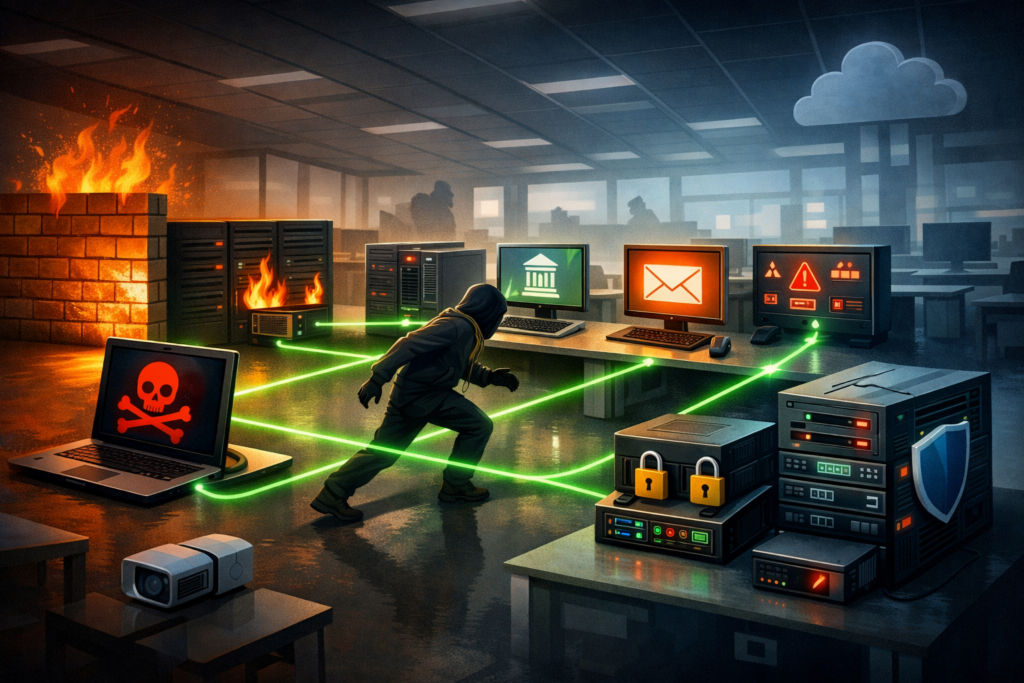
Ransomware is not a file problem. It is a movement problem. When one laptop gets compromised, attackers do what every crew does: they move sideways and hunt for the systems that run payroll, production, and email. If your network is one big room with one lock on the front door, you have given them access to every cabinet.
Canadian SMBs get crushed here because flat networks are normal. One firewall, one LAN, everything talks to everything, and nobody notices lateral traffic until backups start failing. The Canadian Centre for Cyber Security promotes the 80 20 rule for SMEs for a reason. Do the foundational controls well and you stop most real world damage.
The myth that keeps ransomware profitable
Myth: We have a firewall, so we are segmented.
Reality: A perimeter firewall protects the edge. Ransomware does not care about the edge once it is inside. If a compromised user can reach your file server, domain controller, RMM tool, and backup repository from the same network, the blast radius is your whole business.
Quick test: from a normal user laptop, try to reach the backup console and your hypervisor interface. If you can, segmentation is theatre. Fix those paths first before you buy tools.
The 10 day network segmentation sprint
This is the playbook we use at 010grp when a client wants measurable ransomware risk reduction without a long redesign. You can do it with the gear you already own, if you are willing to be strict.
Days 1 to 2: Map what actually matters
- Crown jewels: finance systems, ERP, HR data, customer personal information, and your Microsoft 365 or Google Workspace admin plane.
- Control plane: Active Directory, Entra ID connectors, RMM, backup consoles, hypervisors.
- Noise: printers, IoT, guest WiFi, breakroom tablets, anything that should never touch sensitive data.
Days 3 to 5: Create zones, then deny by default
Build 4 to 6 network zones and treat them like separate mini businesses.
- User zone: laptops and desktops. They should reach only what they need.
- Server zone: file servers, app servers, databases.
- Admin zone: jump box, admin workstations, management interfaces. No email browsing here.
- Backup zone: immutable repositories and backup controllers, reachable only from backup infrastructure.
- Untrusted zone: guest, IoT, printers. Internet only, no lateral access.
Then make the hard move: block traffic between zones by default and allow only explicit flows. This one decision is what stops one click from becoming every system.
Days 6 to 7: Segment identity and privilege
Segmentation fails when privileged accounts live in the same identity pond as regular users. Split admin accounts, enforce phishing resistant MFA for admins and finance, and put privileged actions behind approval. Pair your design with identity and access management, MFA, and PAM so one stolen credential cannot become total control.
Days 8 to 9: Watch lateral traffic
Network segmentation without detection is just hope with VLAN tags. Centralize firewall and server logs, alert on new inter zone connections, and hunt for what ransomware needs: mass SMB connections, remote service creation, and credential dumping attempts. If you are not staffed for it, pair segmentation with incident response planning and the ideas in Your MFA Isn’t Enough: The 7 SIEM Moves Canadian SMBs Must Make Now.
Day 10: Prove recovery, not backups
Ransomware crews go after backups early. Put backups in their own zone, lock down admin access, and test restores on a schedule. Start with the baseline controls for SMEs and keep the ransomware prevention and recovery guide bookmarked. For an additional perspective with operational detail, CISA’s StopRansomware guide is worth reading.
Why this matters in Canada
A ransomware incident is not just downtime. If personal information is exposed, you can end up in breach reporting and customer notification territory under PIPEDA, and Quebec Law 25 raises the bar even more. Fast containment shrinks the scope and the legal mess. The Office of the Privacy Commissioner of Canada explains what to report and what to document in its breach reporting guidance.
Where 010grp fits
Network segmentation is one of the highest ROI controls in ransomware defence, but it is easy to do poorly. 010grp designs the zone model, hardens identity, tunes firewall rules, and backs it with continuous monitoring and tested recovery. If you want a bigger security operating plan, read Hackers Don’t Break In, They Log In and then book a call. We will tell you what to segment first, what to block, and what to monitor so ransomware cannot turn one compromised device into a company wide outage.
Flat Network? Canadian SMBs Are One Click From Ransomware